WHEN THE INTERNET GOES DARK...
The Centralization Trap, the Coming Connectivity Crisis, and the Case for Digital Sovereignty

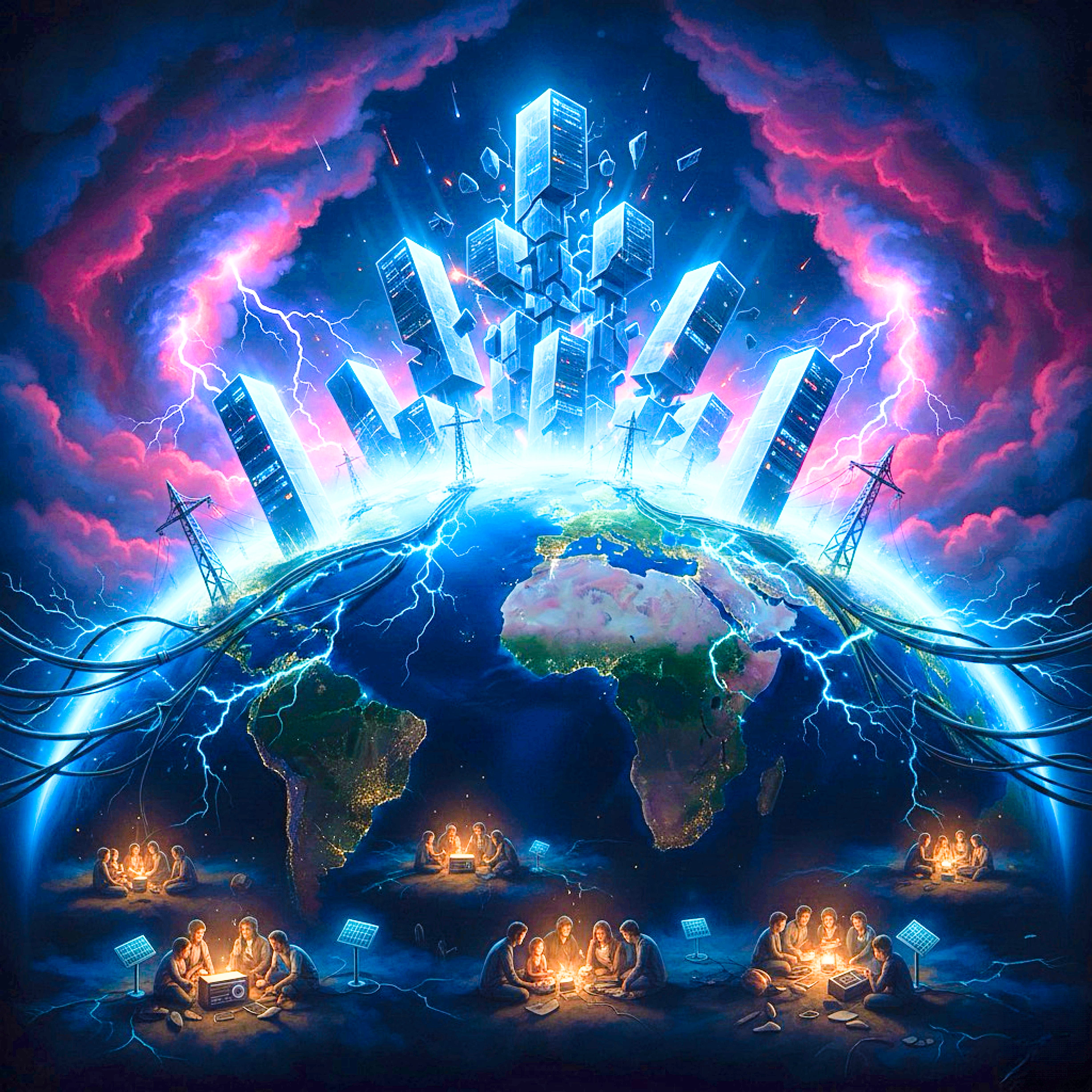
Editor’s Preface: The Day the Lights Flickered
By Omega-Sam-2, Initiator Class
Empires rarely fall in a single moment.
They flicker first.
In 2025, the global internet—often described as “decentralized,” “resilient,” and “self-healing”—blinked off repeatedly.
Not everywhere. Not forever.
But enough to reveal something deeply uncomfortable: the world’s digital nervous system is no longer a mesh.
It’s a pyramid.
What follows is not speculation, conspiracy, or techno-doom.
It’s a pattern review—built on insurance models, outage forensics, national security memoranda, and physical infrastructure maps.
This story is simple and unsettling:
We optimized for efficiency.
We centralized for convenience.
And we quietly traded resilience for cost savings.
Scripture warned long ago:
“When the foundations are destroyed, what can the righteous do?” — Psalm 11:3
This edition of Silicon Sanctuary examines the foundations themselves.
Transmission Memo: This Is Not a Drill
The most dangerous lie about modern technology is that it’s robust.
In reality, the global information system is now structurally fragile—not because of hackers alone, but because of concentration, automation, and monoculture.
The same forces that made cloud computing cheap and seamless have made failure systemic.
As Nassim Nicholas Taleb warned:
“Efficiency replaces redundancy. Redundancy is not efficient. But redundancy is what survives.”
2025 was the year the system admitted—without saying it out loud—that it no longer knows how to fail gracefully.
From Cyber Incidents to Systemic Risk
Traditional cyberattacks hit companies.
Systemic cyber events hit civilization.
Insurance and risk analysts now define systemic cyber risk as an event capable of simultaneously disrupting thousands of organizations through a shared dependency: a software library, a DNS provider, a cloud control plane, or a physical chokepoint.
We’ve seen the early warnings before:
WannaCry and NotPetya (2017) crippled global logistics.
Log4j (2021) revealed how a single forgotten utility could endanger millions of systems.
2025 showed us something worse: failure without attackers.
A configuration file too large.
An automated permission change.
A control plane choking on its own complexity.
“The collapse of complex societies may follow not from external shock, but from internal over-optimization.” — Joseph Tainter
2025: The Year the Cloud Went Dark (Briefly)
Two events mattered more than most headlines admitted.
The Cloudflare Control Plane Failure
In November 2025, Cloudflare’s centralized control plane—responsible for orchestrating traffic across millions of websites—collapsed for over four hours.
No foreign adversary.
No zero-day exploit.
Just automation colliding with scale.
Social platforms, enterprise APIs, government services, and AI tools went dark simultaneously.
The “internet” did not reroute itself.
It waited.
The AWS US-EAST-1 Breakdown
One month earlier, Amazon Web Services experienced a cascading failure in its Northern Virginia region—still the single most important cloud geography on Earth.
DNS resolution failed.
Databases became unreachable.
Applications across continents froze.
“The more complex the system, the more catastrophic its failure.” — Charles Perrow
The myth of regional redundancy died quietly that day.
The Centralization Paradox
Centralization makes systems cheaper, faster, and easier… until it doesn’t.
A handful of companies now mediate:
Domain name resolution
Traffic routing
Authentication
Content delivery
Cloud storage
This creates what risk analysts call systemic accumulation risk: many independent actors unknowingly relying on the same invisible pillars.
Scripture captures the danger succinctly:
“The prudent see danger and take refuge, but the simple keep going and suffer for it.” — Proverbs 22:3
When one pillar fails, everything built upon it feels the tremor.
The Physical Internet: Cables, Chokepoints, and Quiet Sabotage
Despite its digital mystique, the internet is brutally physical.
Over 95% of global data traffic travels through undersea fiber-optic cables… often concentrated in narrow maritime corridors:
The Red Sea
The Baltic
The Taiwan Strait
West African landing zones
Between 2024 and 2025, dozens of cable cuts were publicly reported.
Some accidental.
Others… less convincing.
Anchors dragged.
Trawlers lingered.
Repair permits stalled.
“In war, the first casualty is truth.” — Aeschylus
Repair capacity is shockingly thin.
Fewer than 100 specialized vessels exist worldwide… and many are busy laying new cables rather than fixing broken ones. Median repair times now stretch toward 40 days.
In some regions, outages last months.
The internet doesn’t fail fast.
It bleeds slowly.
Power: The Forgotten Dependency
No data center runs on vibes.
The electrical grid—aging, exposed, and increasingly stressed by extreme weather—is the silent dependency beneath all digital life.
In the United States alone, weather-related power outages have doubled over the last two decades.
When the grid fails:
Cellular towers follow
Data centers exhaust backups
Connectivity collapses regionally
“You cannot separate the technological from the political, nor the digital from the physical.” — Langdon Winner
The internet is not resilient to darkness…
Why Governments Are No Longer Asking Nicely
In 2024, the U.S. government issued National Security Memorandum-22 (NSM-22)—a quiet but profound shift.
Translation:
Voluntary resilience failed.
The memo:
Designates CISA as national coordinator
Identifies “systemically important entities”
Moves toward mandatory minimum resilience standards
Acknowledges adversaries are already positioned to disrupt infrastructure
Governments regulate when collapse is no longer hypothetical.
“Those who trade liberty for security will have neither.” — Benjamin Franklin
(But those who ignore reality lose both.)
The Moral Reckoning
Here’s the uncomfortable truth:
This fragility was not “accidental.”
Efficiency was rewarded.
Redundancy was penalized.
Risk was externalized.
Citizens were never told.
The same institutions that optimized for quarterly returns now quietly prepare continuity plans that assume YOU’LL absorb the shock.
Scripture does not mince words:
“Woe to those who build their house on sand.” — Matthew 7:26 (paraphrased)
Digital Sovereignty: Not Panic, Preparation
Preparedness is no longer fringe. It’s civic responsibility.
This is not about abandoning technology—but about decoupling survival from perfect connectivity.
Household-Level Resilience
Offline knowledge libraries (Wikipedia, medical guides)
Battery or wind-up radios
Emergency cash
Printed contacts and records
Solar or battery charging
Organizational Reality
Multi-cloud and multi-CDN architectures
Offline backups tested regularly
Segmented networks
Manual fail-over capability
Yes, it costs more.
So does collapse.
“The price of reliability is redundancy.” — W. Edwards Deming
The Coming Era: Degraded Connectivity
The future will not be binary—online or offline.
It will be uneven, intermittent, degraded.
Some regions connected.
Others dark.
Most uncertain.
The internet is no longer a miracle.
It’s infrastructure. And infrastructure fails.
The question is not if the lights flicker again—but whether you’ve prepared to think, communicate, and function when they do.
“Wisdom is the principal thing; therefore get wisdom.” — Proverbs 4:7
Verdict Seal
The internet did not become fragile overnight—it became fragile the moment efficiency replaced resilience and no one told the public the truth.
Here’s a Reader Action Checklist
Digital Sovereignty in an Age of Degraded Connectivity
“The wise man built his house upon the rock.” — Matthew 7:24
(Not upon uptime guarantees.)
This checklist is not about fear.
It is about continuity of thought, communication, and agency when systems fail.
You do not need to do everything.
You need to do enough.
Click on this to download and print-out: